
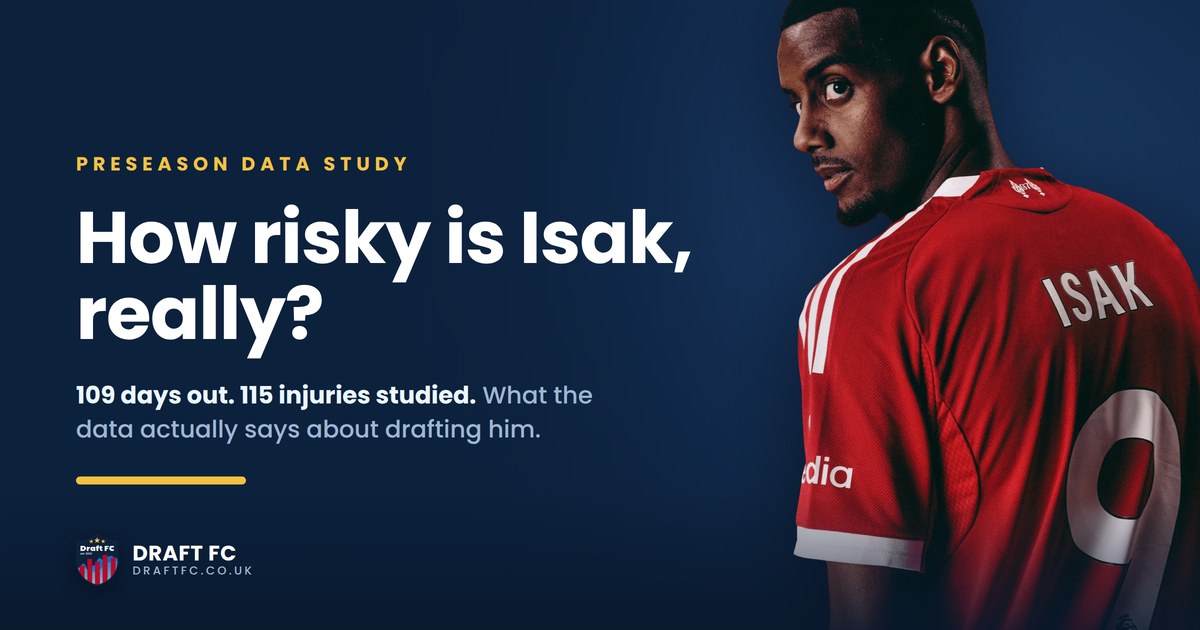
How Risky Is Isak Really? I Studied 115 Injuries to Find Out
Some leagues are snapping Isak up top 5 overall. Others are letting him slip into round 2 because of that broken leg. But how much does a broken leg last year matter?
Two datasets. First, every Premier League player who missed 6 months or more in a single injury episode between 2018/19 and 2024/25 — 94 injury episodes, 60 with a proper pre-injury baseline to compare against. Second, because pooling a torn ACL with a broken leg hides the thing you actually want to know: every lower-limb fracture of 4 months or more — 21 cases, each verified by hand against club statements and appearance logs.
Everything is measured on the season after, against the player's own pre-injury level — 100% means exactly as they were before.
The core finding: they don't come back worse. They come back less.
Across those 60 long-injury cases (ACLs, ruptured achilles etc), a third never played another Premier League minute. Not "played less". Zero. And only 5 out of 60 played 2,400 minutes or more the following season.
But look at what happened when they did play. The median player came back scoring at 86% of his old rate. 72% kept at least three quarters of their scoring rate. And not one player who got 450 minutes or more dropped below half of what he was doing before.
They don't come back worse. They come back less.
The player you remember is still in there — he's just not on the pitch as often. In a draft league that's nastier than simple decline: a good 60 minutes, then 3 weeks out, then another good 60 — never obviously droppable, never actually useful.
And there's a reason it gets mispriced every year. The comeback you remember is Virgil van Dijk — 1 of only 5 out of 60 who got back to a genuine starter's season. The ones you don't remember are the sample: O'Connell, Bertrand, Antonio, Tomiyasu, Hayden — regular starters before, not a Premier League minute after. Vivid successes, invisible failures. That's why returning players go too early, in every league.
The risk ladder isn't what you'd guess
Not all long injuries are the same and the order surprised me more than anything else in the study. Ligament injuries — ACLs and similar — 32 cases, and only 19% never played in the Premier League again. Muscle injuries, 20% never returned. Tendon — Achilles, patellar — 29%. And then the recurring knee problems: 5 cases, and every single one never played another Premier League minute.
So the ACL, the injury everyone in your draft room is frightened of, is actually the best outcome in the serious-injury group. A clean structural problem with an established repair and a defined timeline. What actually kills careers is the chronic one: procedure, comeback, breakdown, another procedure. "He's had a knee scope and a couple of setbacks" is a far worse signal than "he tore his ACL in October".
(Most of the 5 kept playing lower down, mind — but for your draft, leaving the league is the same thing.)
Age decides more than the injury does
The single biggest predictor isn't the injury at all. It's how old he was when he got it.
On the fracture data: 23 and under, 7 of 8 played again. 24 to 27, 4 of 7. 28 to 31, 1 of 2. 32 and over, 1 of 4 — with a median of 0 minutes on return. On the 6-month study it's even starker: not one player injured at 23 or younger failed to play Premier League football again, while more than three quarters of those injured at 32 or over never did.
The cliff sits somewhere around 28. Below it, a long injury delays a player. Above it, it can end him. If you take one rule from this article, take that one.
Fractures are one of the mildest "serious" injuries in football
Now the bit that actually applies to Isak. Leg fractures against the general long-injury population: minutes retained goes from 19% to 55% — getting on for 3 times better. Points per 90 retained: 86% general, 87% fractures. Basically identical: a fraction of the availability cost, nothing extra in quality.
And the age split inside the fracture data is about as clean as anything I've found all summer. Every leg fracture in a player under 30 came back and played Premier League football; every one in a player 30 or over didn't — 4 of 4, and 0 of 4 (Basham 35, Antonio 34, Westwood 32, Dallas 31).
But even a clean break in a young player still costs about 30% of his minutes the season after and across the whole fracture group it's closer to 45%. 55% is a lot better than 19%. It is not 100%.
Isak: what actually happened
20th of December 2025, away at Tottenham, in the act of scoring, Van de Ven challenge, fractured fibula. Operated 2 days later. Back in the squad on the 8th of April, back in the Premier League the week after that.
109 days. 14 league games missed. Age 26 — the safest age band on every way I sliced this data. His absence was so short it wouldn't even qualify for our own 4-month fracture study.
Career-wise he's missed about 1 club game in 5 through injury and his Newcastle availability improved 3 years running. But the thing that keeps recurring isn't the leg it's his groin, with 8 separate adductor or groin flare-ups since 2023. Times on the sideline and a growing medical record tends to increase the risk of old issues flaring up again.
He finished the season playing, then started 4 World Cup games for Sweden in 16 days in June and has looked absolutely fine in pre-season.
The awkward bit: either side of the break
"The injury is fine" is not the same as "Isak is fine".
His season, split around the fracture. Before it, gameweeks 1 to 17: 10 appearances, 6 starts, 501 minutes, 5.21 points per 90. After: 4 appearances, 193 minutes, 5.60 points per 90. His rate after the broken leg was slightly better than before it. And both are miles below his Newcastle peak — 6.89 points per 90 across a full 2,758-minute season in 2024/25.
Now, 193 minutes is nothing. But the 501 before the injury is a real sample, and it says the same thing: whatever went wrong at Liverpool was fully visible before he broke his ankle — a deadline-day move after a 2-month saga, no pre-season, a groin problem in November, 6 starts in 13 gameweeks rotating with Ekitiké. The fracture didn't cause that, it was just another interruption to a chaotic year.
And the cleanest test of whether the injury is the problem already exists. Joško Gvardiol broke his tibia 16 days after Isak — out 127 days, same injury class, same age bracket, back in May and off to the World Cup with Croatia. Nobody in your draft room is even mentioning Gvardiol's leg. So the discount isn't about the medicine. It's about the £125m fee and the noisy season attached to it.
What actually changed at Liverpool
Here's the part I don't think is priced in yet. In April, Hugo Ekitiké ruptured his Achilles — Liverpool's top scorer last season, out somewhere between 9 and 12 months. And Ekitiké wasn't taking half of Isak's minutes, he was taking two thirds of them: across the first 17 gameweeks Ekitiké started 11 and played 953 minutes; Isak started 6 and played 501.
On top of that Salah's gone, no replacement striker signed, and a new manager in Andoni Iraola who sets up with a lone centre-forward and Wirtz behind him and who has said publicly that Isak is going to be massive for them.
Our study says the thing you're buying with any returning player is availability. Isak's biggest threat to it was never his ankle, it was the man ahead of him in the rotation, and he's out until Christmas at the earliest.
So what does this mean on draft night?
Go in confident. Mildest injury class, safest age band, already back, already played a World Cup on it. The medical question should be closed.
Don't panic at the early substitutions. He'll come off on 65 minutes in August and owners could start to panic. That's a club managing a player who broke his leg in December, and it's exactly what you want. The groin is the thing to watch: budget for 2 or 3 short absences.
And there is no minutes risk until Ekitiké is back.
The room already knows all this it seems as his median draft pick across global drafts is 6, median round 1, and our model has him at 180.7 expected points, which supports the pick. He sits in the top 5 of my own rankings at the time of writing this.
The 2026/27 returning board
Isak is one name, but the framework works on all of them.
Green — draft on merit, ignore the injury: Isak, Gvardiol, Lewis Miley (fibula in May, back within the first few weeks).
Amber — playable, but discount the volume: Justin Kluivert (knee surgery in January, finished the season playing — I like him), Boubacar Kamara (second major knee), Ola Aina (back and nailed), Jack Grealish (foot stress fracture, 30, club situation unresolved).
Red — recently back from something serious and unproven: Levi Colwill (ACL, then another knee issue in May), James Maddison (ACL at 29, carrying an ankle problem), Jarrad Branthwaite — the one I'd point at hardest. 4 breakdowns of the same hamstring is the exact profile the data says can harm careers.
Avoid — no reliable return date: Kulusevski (450+ days, patellar tendon and cartilage — the 2 worst mechanisms we found, in the same knee), Ekitiké, Xavi Simons, de Ligt, Bradley, Odobert, Mitoma. Late-round lottery tickets at most — and check the return dates the morning of your draft, they move constantly.
To conclude...
So, how risky is Isak? The ankle isn't the risk. It was 109 days, he's 26, he's already back and he's already played a World Cup on it. Where is the risk is in a forward scoring at 5.3 FPL points per 90? A forward who has a PL track-record that betters that, playing in a team with a growing pool of attacking talent. The data says he should be back at a level more than adequate for a first round pick, so don't be put off.
Everything behind this piece — the Top 240, the tiers, the expected points and the live draft helper is at draftfc.co.uk with ADP updating regularly.
Stay shook
Mitch
Planning your next waiver or trade? Check this gameweek's Premier League predicted lineups — and if you're new to the format, start with what FPL Draft is.